Every Snack You Make: An Embroidery Design Review
As a designer who has stitched out thousands of files for both personal enjoyment and commercial client work, I approach every new machine embroidery design with a healthy dose of skepticism. We have all purchased files that looked stunning on screen but turned into thread nests or distorted shapes once the needle hit the fabric. When evaluating "Every Snack You Make," my primary focus is not just on the cute factor, but on structural integrity and real-world application. This review breaks down how this specific Dogs themed design performs when moved from digital preview to physical embroidery project.
First Impressions and Visual Personality
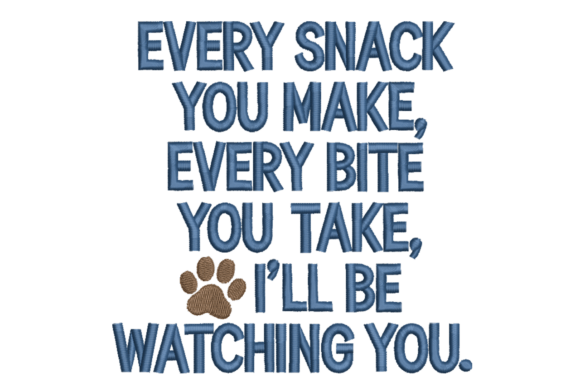
The immediate appeal of Every Snack You Make lies in its relatable humor and clear silhouette. For those of us in the craft business or running an Etsy shop, designs need to communicate their message instantly. A customer scrolling through a feed decides in seconds whether a product speaks to them. This design captures that specific dog-owner niche perfectly without being overly cluttered. The layout suggests a balanced composition that would serve well as a centerpiece rather than a subtle accent.
Visually, the artwork appears to rely on distinct outlines and manageable fill areas. From a digitizing perspective, this is promising. Designs with excessive detail often suffer when scaled down, but the bold nature of this theme implies it will retain clarity across various sizes. The mood is lighthearted and domestic, making it an ideal candidate for items associated with home, comfort, and pets. It avoids the trap of being too generic; it has enough personality to stand alone on a plain background while remaining versatile enough to pair with other elements in a larger collection.
Real-World Application: The Custom Tote Bag Test
To truly judge an embroidery file, you must imagine it in context. For this review, I mentally placed Every Snack You Make on a canvas tote bag intended as a personalized gift for a dog sitter. Tote bags are a staple for Etsy sellers and small shop products, but they present unique challenges due to the coarse weave of canvas and the lack of stretch.
In this scenario, the design needs to anchor securely without pulling the fabric. If Every Snack You Make utilizes heavy satin stitch borders, there is a risk of the canvas puckering if the tension isn't perfect. However, if the digitizer has incorporated adequate underlay and perhaps some running stitch detailing to break up large fill areas, the result should be crisp. For a tote bag, I would recommend testing the design first to ensure the text remains legible from a distance. The humor relies on readability; if the lettering gets lost in the texture of the bag, the impact fails. Assuming the stitch density is optimized for medium-weight fabrics, this design could easily become a best-seller in a pet lover’s boutique lineup.
Fabric Compatibility and Hoop Considerations
Not every design plays nicely with every textile. When planning to use Every Snack You Make, you must consider your substrate carefully. Here is how I anticipate it performing across common materials:
- Sweatshirts and Fleece: These are high-value items for custom apparel. The pile of fleece can swallow fine details. If this design includes tiny text or thin lines, you may need to use a water-soluble topping to keep the stitches visible. The design likely has enough body to sit well on fleece, provided you use a cut-away stabilizer to prevent stretching during the stitch-out.
- Kitchen Towels and Linens: Given the snack theme, tea towels are a natural fit. Woven cottons are generally forgiving, but they can distort if the stitch density is too high. Check the file properties before stitching. If the design is extremely dense, it might make the towel stiff and unabsorbent, which detracts from the utility of the finished product.
- Baby Items and Onesies: Caution is required here. While baby embroidery is popular, infant skin is sensitive. Large, dense designs can create a rough backing that irritates skin. If using Every Snack You Make on baby gear, ensure the back is smooth or lined, and verify that the design size is appropriate for the small garment area.
- Caps and Curved Surfaces: Unless the file is specifically digitized for caps with a center-out stitch sequence, avoid using standard flat versions on curved brims. The distortion on a cap will ruin the alignment of text and graphics.
Commercial Viability for Makers and Sellers
For creative entrepreneurs, time is money. A design that requires constant troubleshooting eats into profit margins. Every Snack You Make appears to be structured for production efficiency. The color changes seem logical, minimizing thread swaps and reducing the chance of operator error during bulk runs. This is crucial for commercial embroidery where consistency across ten aprons or twenty pillows is non-negotiable.
Furthermore, consider the marketing aspect. Does this design photograph well? High-contrast embroidery tends to perform better in printable mockups and social media photos. The thematic clarity of this design means it doesn't require extensive styling to sell itself. A simple flat lay of an embroidered apron featuring this design tells the whole story. For digital product sellers offering this file, providing accurate size charts and fabric recommendations in the listing description will reduce customer support inquiries and increase buyer confidence.
Critical Pre-Stitch Checklist for Success
Before you commit Every Snack You Make to your final merchandise, run through this professional checklist. Skipping these steps is the difference between a hobbyist result and a professional handmade product.
- Verify Licensing: Never assume. Confirm whether your purchase includes commercial rights for selling finished goods or if it is for personal use only. Protect your business by respecting intellectual property.
- Test Stitch on Scrap: Always use a scrap of the exact fabric and stabilizer combination you plan to use for the final item. A test on felt tells you nothing about how the design will behave on stretchy jersey or textured linen.
- Check Thread Contrast: View the design in black and white on your machine or software. If the values are too similar, the details will vanish. Adjust thread colors to ensure the focal points pop against your chosen fabric background.
- Inspect Small Details: Zoom in on the digital file. Are there satin stitches thinner than 1mm? These may shred or disappear. Is the text height sufficient for the smallest hoop size you intend to use? Legibility is paramount.
- Stabilizer Selection: Match the stabilizer to the fabric weight and the design density. Using tear-away on a dense design applied to knit fabric is a recipe for disaster. Invest in quality cut-away or no-show mesh for apparel to ensure longevity.
- Mockup Validation: Create a visual mockup to check placement. On a sweatshirt, is the design centered correctly relative to the neckline and seams? Proper placement elevates the perceived value of personalized gifts and retail items.
Final Thoughts on Design Integrity
Every Snack You Make represents the kind of niche-specific, emotionally resonant art that drives the embroidery community. It bridges the gap between technical execution and sentimental value. Whether you are creating a holiday embroidery gift for a fellow dog mom or stocking your shop with new design assets, success depends on respecting the mechanics of the medium.
By treating this embroidery file with professional scrutiny—testing densities, selecting appropriate stabilizers, and verifying commercial suitability—you transform a digital download into a tangible asset. The design has strong potential for tote bags, apparel, and home decor, provided the maker applies sound judgment regarding fabric choice and finishing techniques. Ultimately, the quality of your finished product reflects not just the digitizer's skill, but your own dedication to the craft. Stitch with intention, test thoroughly, and let the personality of the design shine through in every project.